

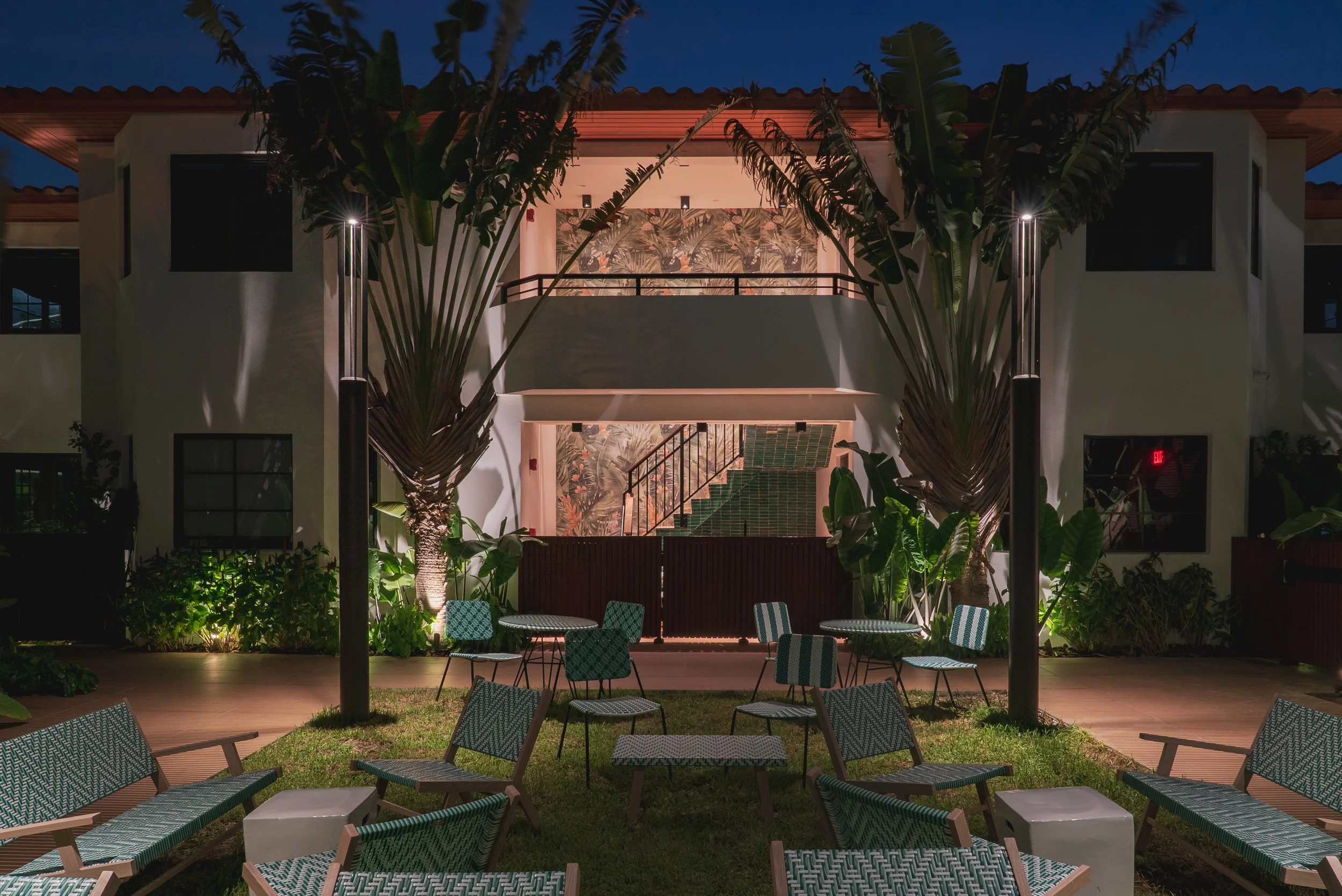
Most people come to Miami Beach for the Art Deco on Ocean Drive. The style that came after it lives up here, at the north end of the island, and you can see a good deal of it on foot from our gate. This is how we'd explain it to you over coffee in the courtyard.
What MiMo architecture is
MiMo is short for Miami Modern, the regional style that took shape in South Florida between about 1945 and 1960. After the war, car ownership spread, air travel got cheaper and the tourists came. Hotels, motels and small apartment buildings went up quickly to meet them, and by the late 1940s modernist design had largely replaced Art Deco on the beach.
The features to look for are consistent:
- Breeze blocks: perforated concrete screens that let air through and throw patterned shade.
- Flat roofs and smooth corners: clean lines, with a curve or a circular cutout placed next to a sharp angle.
- Glass: large windows and whole glass walls that blur inside and out.
- Open-air walkways and outdoor stairs: units reached from the outside, often around a garden.
- Interior gardens: planting set inside the building rather than in front of it.
Architectural historians describe two strains. Resort MiMo is the showier one, borrowing from Hollywood sets, car design and the space race: boomerang shapes, trapezoids, signage meant to be seen from a moving car. Subtropical Modernism is the quieter strain, applied to houses, apartment buildings and civic buildings designed around the heat and the light. The name itself is recent. It's credited to Miami Beach resident Randall C. Robinson and interior designer Teri D'Amico.
Where to see MiMo in Miami Beach
The answer is the north end. The style is most visible along Collins Avenue in Middle and Upper Miami Beach, and the clearest single area to walk is the North Shore Historic District in North Beach.
The district was added to the National Register of Historic Places on 18 November 2009. It's roughly bounded by 73rd Street, 87th Street, Collins Avenue and Hawthorne Avenue. Most of what stands there is Miami Modern, with Mediterranean Revival, Art Deco and Moderne buildings mixed in. That mix is the useful part: you can see the older styles and the newer one side by side on the same block, which makes the change easier to read than any textbook.
We're at 7418 Harding Avenue, a block in from Collins and inside those boundaries. So a MiMo walk doesn't need a car or a ticket. Step out of our gate, go north, and keep to the residential streets west of Collins. Look up at the stairs and walkways, and look sideways at the breeze-block screens on the walls facing the street.
When to walk it
Go early. We'd say before ten, when the shade from the screens is still long and the pavements haven't warmed. The courtyard pool opens at sunrise, so a swim first and a walk second is how we'd do it. Breakfast at The Breakfast Table runs 7 to 11, which leaves time to come back and eat after.
An hour is enough to cover a good part of the district at an easy pace. If you want to keep going, turn south afterwards to 71st Street, North Beach's main street, for a coffee at one of the open-air cafés.
MiMo beyond the island
The other well-known MiMo area is on the mainland, across the bay. The MiMo Biscayne Boulevard Historic District, which locals call MiMo on BiBo, runs roughly from 50th Street to 77th Street along Biscayne Boulevard. It's mostly motels and commercial buildings from the same years, and it's worth the trip if you're already headed to the Design District. Each early May the area holds Cinco de MiMo, a festival built around the architecture.
One mainland building often used as the example of the style is the Bacardi Building in Edgewater, finished in 1963. It's a good one to see if you only have time for one.
If you want the older style too, the Miami Design Preservation League runs the official Art Deco Walking Tour from the Art Deco Welcome Center at 10th Street and Ocean Drive. The ticket includes entry to the Art Deco Museum. It's a fair comparison to make after a morning up here: you'll see what MiMo was reacting to.
Our house, built in 1948
Our building dates from 1948, the first years of the MiMo period. We won't call it a textbook example of the style. What we will say is that it's built around a courtyard, with the pool and garden at its centre, which is the same idea those postwar buildings were organised around: life turned inward, toward shade and planting.
Inside, Felix designed each room himself, and every piece is custom. There are 29 rooms. Mark Cherry's commissioned pieces hang on the walls, and the floors carry a teak yacht deck pattern underfoot. Everything here carries Felix's personal touch.
If you're the kind of traveller who reads a building before you read the menu, North Beach is the end of the island that will reward you. This is the slower Miami.